What separates good from poor PVC edge banding?
Most buyers start by comparing thickness, color, and price per meter. Those matter—but they do not explain why one 0.8 mm band runs cleanly at high speed and another whitens at the trim station, or why one cabinet edge still looks sharp after three summers while another has already lifted.
For details relevant to this topic, review PVC edge banding range and our quality process.
The real difference is the compound and the control behind it. PVC resin gives the band its toughness and strength. Calcium carbonate controls cost and improves dimensional stability. Plasticizer sets the hardness. Stabilizer determines heat and yellowing resistance. The back-side primer decides whether the hot melt actually grips. Get any one of them wrong, and the failure appears later—on your line or in your customer’s kitchen.
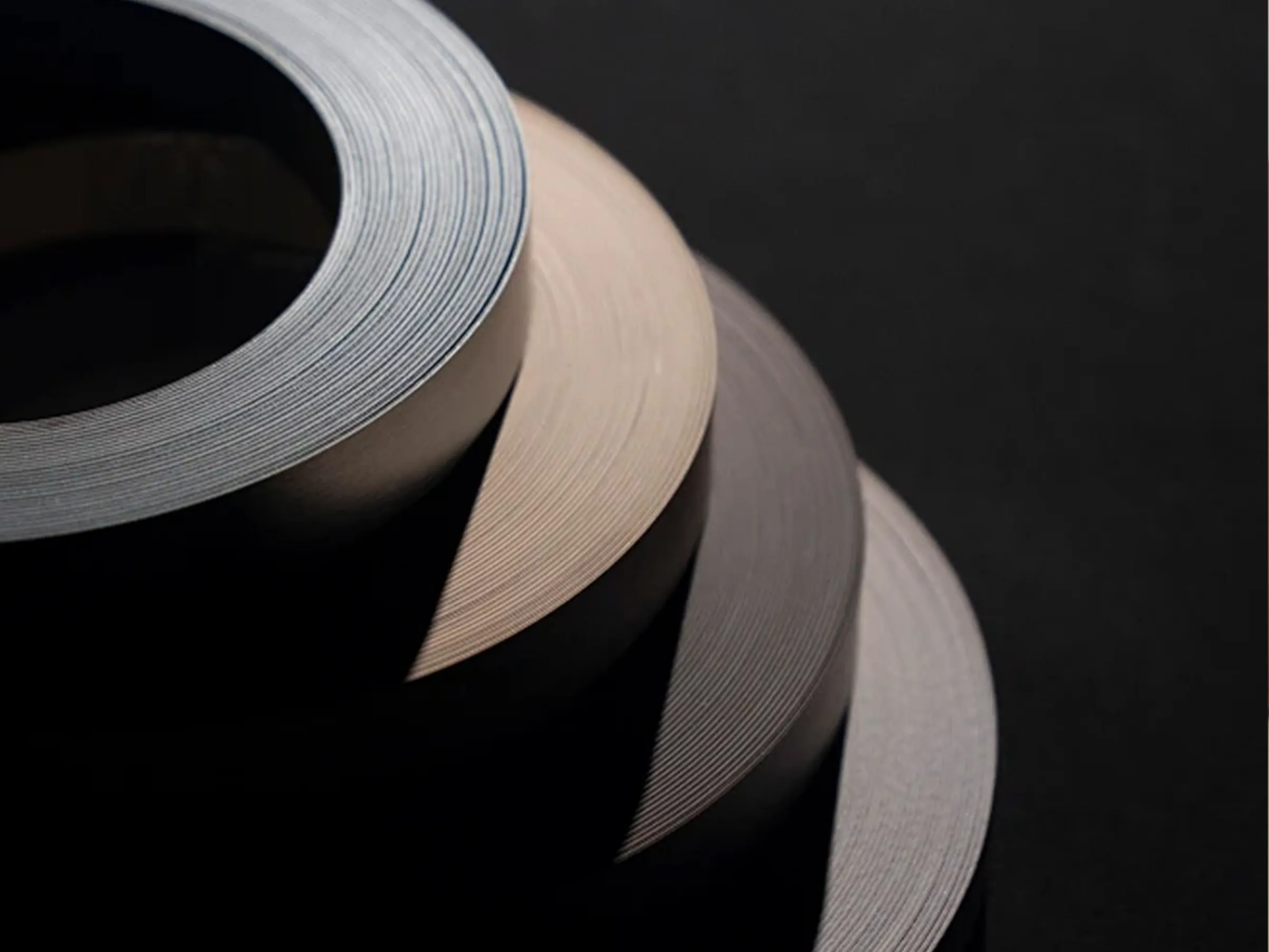
How resin and filler affect edge banding quality
A useful way to think about PVC edge banding is reinforced concrete. The PVC resin is the steel: it provides strength, flexibility, and rebound. Ground calcium carbonate (GCC) is the aggregate: it lowers cost, adds stiffness, and helps the band hold its dimensions.
A common reference ratio in the industry is about 3:1 resin to GCC by weight—roughly 75 parts resin to 25 parts filler. That is not a mandatory standard, and formulations vary with thickness, finish, and application. But at that level, the resin forms a continuous matrix that encapsulates the filler particles and balances cost against performance.
The problem with cheap tape is rarely that it contains calcium carbonate. It is that the resin has been cut too far and the filler pushed too high. Once filler loading approaches or exceeds half the compound, there is no longer enough resin to wet out and bind every particle. The material may look solid, but under stress it behaves like concrete with too much sand and too little cement.
Why low-quality banding breaks and whitens
When resin content falls, the polymer chains no longer hold the structure together effectively. The band becomes harder and more brittle. Bend it or cut it, and the filler particles separate from the resin matrix, creating microscopic voids. What you see is a white line along the fold or the trimmed edge: stress whitening.
That white line is not dirt or a surface mark. It is evidence that the internal structure has already failed. On an edgebander, the same material may chip at the cutter, especially on small radii, shaped panels, and high-speed lines.
Other formulation variables buyers overlook
- Resin grade (K value / degree of polymerization). Two tapes can both claim “PVC resin” and behave completely differently. The wrong grade gives the wrong balance of toughness and melt flow.
- Filler quality. Coarse, untreated, or poorly dispersed calcium carbonate creates stress concentrations. How the filler is treated and dispersed can matter more than the percentage on a datasheet.
- Plasticizer and stabilizer system. Low-quality plasticizers migrate and cause tackiness or odor. A weak stabilizer package shows up as heat distortion and yellowing.
- Recycled content. Recyclate is not automatically unacceptable, but it widens batch-to-batch variation in color, impurities, and mechanical performance—hard for premium furniture programs to absorb.
Quality differences that show up in production
| Dimension | Good-quality PVC edge banding | Poor-quality PVC edge banding | What it costs you |
|---|---|---|---|
| Compound | Virgin resin, balanced filler, matched additives | Excess filler, high recyclate content, weak additive package | Lower toughness, faster aging, unstable batches |
| Color and surface | Uniform color, close panel match, clean surface | Visible color shift, black spots, bubbles, flow lines | Edges look mismatched; premium appearance lost |
| Dimensions | Stable thickness and width, clean slit, flat winding | Uneven caliper, width drift, rough edges | Machine tracking issues, thick glue lines, misalignment |
| Flexibility | Bends with rebound; no cracking or heavy whitening | Hard and brittle; cracks or whitens on folding | Breakage in transport, installation, and winter production |
| Trimming | Clean cut at speed, good small-radius performance | Chips, fuzzes, dulls after polishing | Higher reject rate and faster tool wear |
| Back-side primer | Uniform, firmly anchored, compatible with EVA/PUR | Missing, uneven, or poorly bonded | Lifting and peeling, especially in humid conditions |
| Heat and weather resistance | Resists heat sag, cold cracking, and yellowing | Shrinks or deforms in heat; yellows in sunlight | Lifted edges and color change after installation |
| Abrasion and scratch resistance | Dense UV topcoat, resists daily knocks | Scratches easily; coating wears through | High-touch edges look old quickly |
| Odor and compliance | Low odor; heavy metals and VOC under control; reports available | Sharp chemical odor; possible heavy-metal or plasticizer failure | Compliance risk and brand damage |
| Batch consistency | Color, tolerance, and performance repeat lot to lot | Two batches of the same spec behave like two products | Bulk order does not match the sample; schedule pressure |
Five checks buyers can run without a lab
- Measure. Use a micrometer at several points along the roll and a caliper across the width. Compare with the agreed tolerance, not only the nominal 0.8 mm or 22 mm. Many orders specify ±0.1 mm, but confirm your own specification. What matters most is uniformity within a roll and consistency between lots.
- Bend. Use samples of the same thickness, at the same temperature, with a similar bend radius. Fold repeatedly and watch for cracking, whitening, or delamination. Do not compare a 0.4 mm and a 2.0 mm band using the same force. If the furniture will ship through cold winters, repeat the test at low temperature.
- Inspect. Put the band against the actual panel under natural or D65 light. Check color, gloss, grain alignment, bubbles, black spots, and flow lines. Then cut a section and look for voids, layering, or contamination. The cross-section is harder to disguise than the surface.
- Smell—carefully. A sharp chemical odor is a warning sign, usually pointing to poor raw materials or an unsuitable plasticizer. But odor is a clue, not a verdict: “no smell” does not prove compliance, and “some smell” does not prove toxicity. Ask for RoHS, REACH, and EN 71-3 reports tied to the batch.
- Trial on your line. Run the same panel, the same adhesive, and the same machine settings. Check the glue line, trim quality, corner behavior, and peel strength. Then leave a sample in a hot, humid place to simulate a kitchen or a summer container. This single test is worth more than any hand-feel comparison.
If a dispute arises, ash content testing can estimate the inorganic filler level. Remember that ash is not the same as calcium carbonate content—other inorganic additives leave residue too—so read it together with the formulation record and test method.
Why whitening at the trimmed edge deserves attention
Whitening is the most visible and most underestimated defect in a furniture factory. It means the material has already fractured at a microscopic level during cutting. The consequences compound:
- Higher chip rate, especially on small radii, shaped panels, and high-speed edgebanders.
- More rework—trimming, scraping, and polishing all over again—plus lost machine time.
- Faster tool wear, because heavily filled, poorly dispersed compounds are unkind to cutters.
A band that saves a few cents per meter can cost far more if it sends a batch of cabinet doors back through rework.
Why good edge banding can still peel
This is the point buyers most often miss: good edge banding does not guarantee a good bond. Adhesion is a system:
- Glue temperature. Medium-temperature EVA typically runs at 150–180°C; high-temperature EVA at 180–210°C. Too cool, and the adhesive sits on the surface; too hot, and it becomes brittle.
- Open time and pressure. Once the open window closes, roller pressure cannot recover the bond.
- Panel moisture and edge cleanliness. Adhesive bonds to dust, and dust bonds to nothing.
- Primer-to-glue compatibility. The back-side primer, adhesive type, and panel finish have to work together.
- Storage and environment. Humidity, direct sun, and long-term compression all change how the tape and glue behave.
When an edge lifts, check glue temperature, pressure, feed rate, and edge cleaning before blaming the tape. That order saves a lot of unnecessary material changes.
Questions to ask an edge banding supplier
Price matters, but a low price is often paid back in rework and claims. These questions are more useful than “Is your quality good?”
- Formulation range: What is the approximate PVC resin to calcium carbonate ratio? Is recycled material used? Can you provide batch dosing records?
- Tolerances and color: What are the thickness and width tolerances? How is batch-to-batch color controlled, and can you share Delta E data?
- Primer and adhesive: What back-side treatment is used? Is it designed for EVA, PUR, or both? What machine settings do you recommend?
- Test reports: Can you provide QB/T 4463 test results and RoHS, REACH, or EN 71-3 reports?
- Sampling and trials: Will you send samples and support a trial with our panels and adhesive?
- Batch consistency: How do you ensure bulk production matches the approved sample, and what happens if color or performance drifts?
A manufacturer with its own lines can usually answer with parameters, records, and traceability. A trader can often only answer with assurances.
Match the edge banding grade to the market
Not every order needs the most expensive tape. The right question is which grade fits the market.
| Grade | What it delivers | Best fit |
|---|---|---|
| Economy | Basic appearance, dimensions, and machinability; cost first | Price-sensitive, high-volume markets |
| Standard | Stable formulation and balanced toughness, color, and tolerances | Most custom furniture factories and distributors |
| Premium | Tight control of raw materials, color, surface defects, and batch consistency | High-end custom furniture, export brands, strict environmental programs |
A price-sensitive market does not have to accept tape that whitens on every trim. The better approach is to optimize cost while protecting basic toughness, dimensional stability, machinability, and bond strength—not to cut resin and add filler until the price looks attractive.
Four edge banding myths worth retiring
- “Heavier is better.” No. At the same size, extra weight may mean higher density—or more filler. Weight is a clue, not a verdict.
- “Harder is better.” No. Excessive hardness often means too little resin and too much filler, which shows up at the bend and the trimmer.
- “Softer is better.” Also no. Too soft, and the band curls, deforms, and loses the crisp edge a cabinet needs.
- “No smell means compliant.” Not reliable. Compliance is proven by heavy-metal, VOC, and plasticizer test data. Odor is only a screening signal.
A practical field test
Flexible without being brittle. Clean, uniform surface. Consistent color. Low odor. Stable dimensions. Smooth on the machine.
If you can do only one thing, run a trial on your own edgebander. If you can do two, compare three production batches. A supplier can hand-pick the best sample in the factory, but batch consistency is much harder to fake.
For furniture factories, edge banding is a small share of cabinet cost and a large share of the visual, durability, and compliance impression. Move the conversation from “price per meter” to “cost per finished meter,” and the choice usually becomes clearer.
At Quanyixintong, we have manufactured PVC, ABS, PP, and acrylic edge banding since 2000, and we produce the EVA and PUR hot melt adhesives that bond them. We supply leading Chinese furniture brands such as OPPEIN and ZBOM, as well as distributors across the Middle East, Southeast Asia, Europe, Central Asia, Africa, and the Americas. Thicknesses run from 0.4 to 60 mm and widths from 15 to 600 mm, with custom colors, woodgrains, high-gloss, and metallic finishes. Send us your panel decor, banding specification, and adhesive type, and we will produce matched samples for your own line trial before any bulk order. Visits to our Wuhan factory are always welcome.