Is PVC edge banding still the mainstream choice?
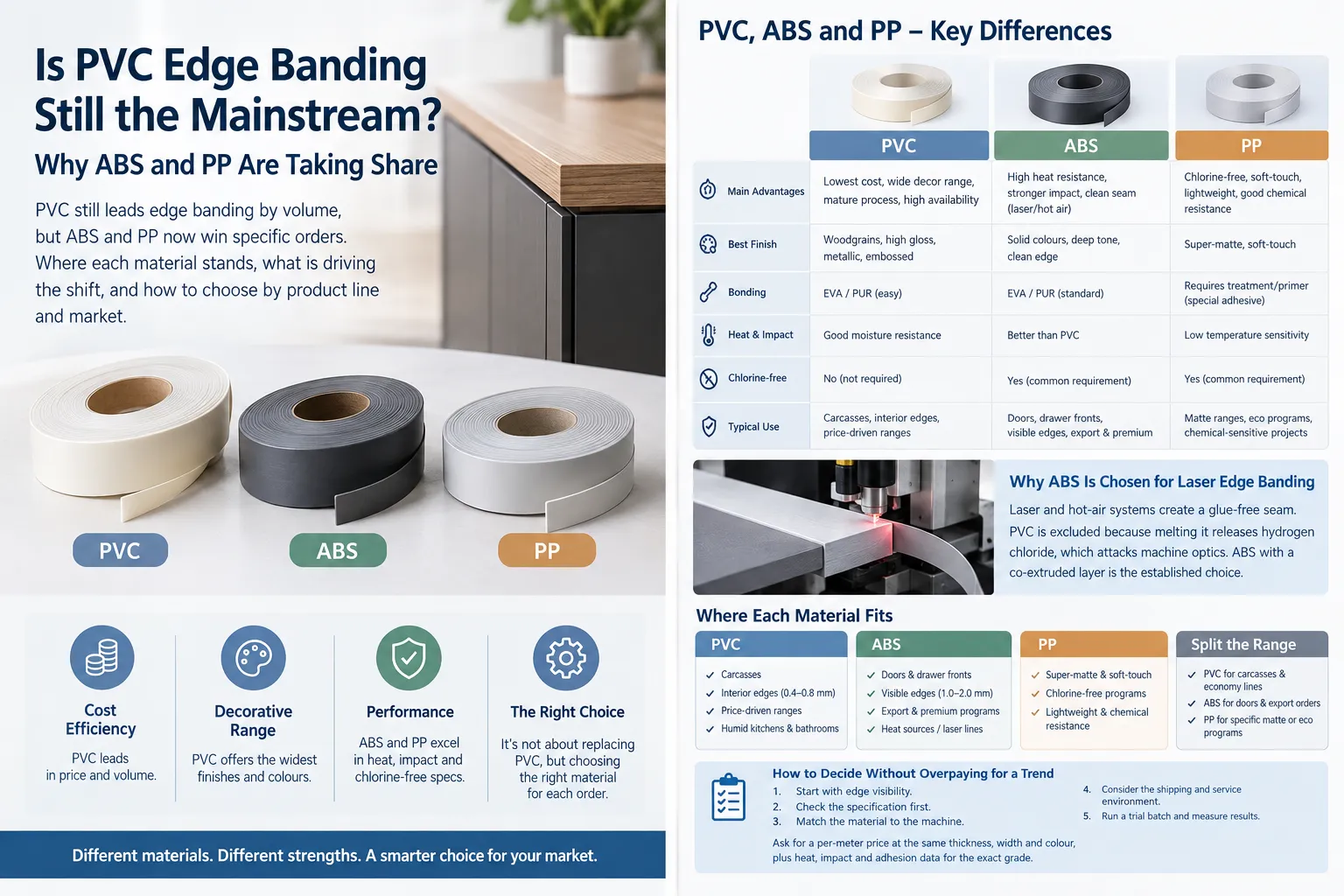
By volume, PVC remains the default edge banding material. Most industry estimates put it above 60% of thermoplastic edge banding globally, and considerably higher in price-sensitive markets. ABS and PP are growing from a much smaller base, and they are not replacing PVC. They are taking specific segments: European retail programs, chlorine-free specifications, laser and hot-air lines, and premium matte surfaces.
For details relevant to this topic, review PVC edge banding range and ABS edge banding; you can also explore PP edge banding.
So the useful question is not whether PVC will be replaced. It is which of your orders are actually moving, and what that costs per meter.
Why PVC edge banding still holds the most volume
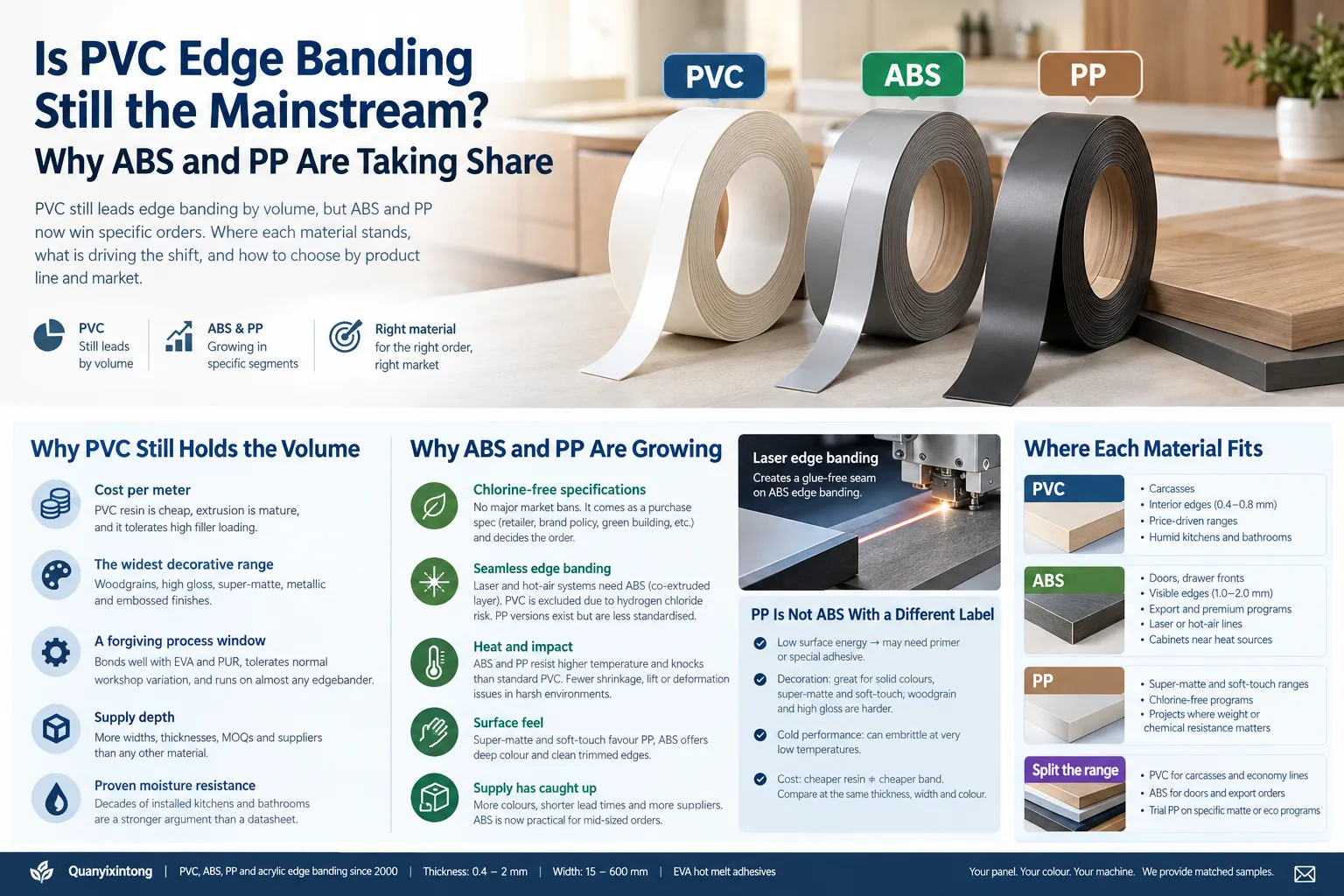
- Cost per meter. PVC resin is cheap, the extrusion process is mature, and the material tolerates high filler loading. For carcass edges and contract work, nothing else comes close on price at the same thickness and width.
- The widest decorative range. Woodgrains, high gloss, super-matte, metallic and embossed finishes were built around PVC. Matching a specific laminate or veneer is fastest, and often only affordable, in PVC.
- A forgiving process window. PVC bonds readily to both EVA and PUR, tolerates normal workshop variation, and runs on almost every edgebander in service. A new colour needs no retraining and no line tuning.
- Supply depth. More widths, thicknesses, MOQs and suppliers than any other material. For a distributor carrying many SKUs, that flexibility matters as much as the price.
- Proven moisture resistance. Decades of installed kitchens and bathrooms are a stronger argument than a datasheet.
Why ABS and PP edge banding are gaining share
- Chlorine-free specifications. This is the biggest driver, and the most misunderstood. No major market bans PVC edge banding. The requirement arrives as a purchase specification instead: a retailer restricted substance list, a brand chemical policy, a green building credit, or a children’s and office furniture program. Once it is in the spec, it decides the order—even though it is a contract term, not a law.
- Seamless edge banding. Laser and hot-air systems melt a functional layer to create a glue-free seam. PVC is effectively excluded because melting it releases hydrogen chloride, which attacks machine optics. ABS with a co-extruded layer is the established choice; PP versions exist but are less standardised. Buy a laser line, and the material question is largely answered.
- Heat and impact. Standard PVC softens at a lower temperature than ABS or PP. In a container crossing the equator, an unairconditioned warehouse, or a cabinet beside an oven, a PVC edge can shrink, lift or deform. ABS also survives knocks better at the same thickness—which turns a few cents per meter into an avoided warranty claim.
- Surface feel. The minimal, low-reflection look in premium residential furniture favours super-matte and soft-touch surfaces. PP does this exceptionally well, with a warm, dry feel and no plasticiser load. ABS offers deep colour and a clean trimmed edge, which is why it dominates thick visible edges.
- Supply has caught up. Five years ago, specifying ABS meant limited colours, long lead times and few suppliers who could match a laminate. That gap has closed, and ABS is now practical for mid-sized orders rather than flagship projects only.
What buyers should know about PP edge banding
PP is the most misjudged material in this conversation. It is genuinely attractive—lower density than PVC or ABS, chlorine-free, good chemical resistance, excellent matte surface—but it behaves differently on the line.
- Bonding. PP has low surface energy, so standard EVA may not wet it properly. Success usually depends on surface treatment or a primer, an adhesive formulated for low-energy surfaces, and tighter control of speed and pressure. A PP quote that does not ask about your adhesive and machine settings is incomplete.
- Decoration. Solid colours, super-matte and soft-touch are its strengths. Fine woodgrain and high gloss are harder than on PVC. Expect a longer development cycle and a higher minimum.
- Cold performance. PP can embrittle at very low temperatures, which matters for cold-climate shipments and unheated storage. Ask for heat-shrinkage and cold-impact data for the exact grade.
- Cost. Cheaper resin does not guarantee a cheaper band. Density, filler, yield and scrap decide the per-meter number. Compare quotes at the same thickness and width.
How to choose PVC, ABS, or PP for your product line
- PVC: carcasses, interior edges at 0.4–0.8 mm, price-driven ranges, humid kitchens and bathrooms.
- ABS: doors, drawer fronts and visible edges at 1.0–2.0 mm, export and premium programs, laser or hot-air lines, cabinets near heat sources.
- PP: super-matte and soft-touch ranges, chlorine-free programs, projects where weight or chemical resistance matters.
- Split the range: most well-run factories keep PVC for carcasses and economy lines, use ABS for doors and export orders, and trial PP on specific matte or eco programs. That confines the premium to the orders that can carry it.
- Start with edge visibility. Hidden carcass edges rarely justify ABS.
- Check the specification before the price. If the customer requires chlorine-free, the decision is already made.
- Match the material to the machine. Laser and hot air point to ABS; PP needs treatment capability and a trial.
- Consider the shipping and service environment. Heat, humidity and long container routes favour higher heat resistance.
- Run a trial batch and measure reject rate, trim quality and glue-line appearance. A sample bent by hand in a meeting room proves very little.
Ask for a per-meter price at the same thickness, width and colour, plus heat, impact and adhesion data for the exact grade. Then decide on your own line, with your own adhesive.
At Quanyixintong, we have manufactured PVC, ABS, PP and acrylic edge banding since 2000, in thicknesses from 0.4 to 60 mm and widths from 15 to 600 mm, alongside the EVA hot melt adhesives that bond them. We supply leading Chinese furniture brands such as OPPEIN and ZBOM, and distributors across Asia, Europe, Africa, North America, and South America—five continents in total. Send us your panel, colour and machine details, and we will produce matched PVC, ABS and PP samples for your own trial—you only place a bulk order after your line confirms the result. Visits to our Wuhan factory are always welcome.

