PVC vs. ABS: Which Material Fits Your Product Line?
PVC and ABS dominate thermoplastic edge banding—PVC alone holds over 60% of that market, with ABS at roughly 10–15% and growing, driven mainly by European buyers. Yet manufacturers keep asking the same question: is ABS worth the premium? The honest answer is that the real cost gap is smaller than the resin price suggests, and the performance gap only matters in specific situations. Here is the breakdown we give our own customers.
For details relevant to this topic, review PVC edge banding range and ABS edge banding; you can also explore PP edge banding.
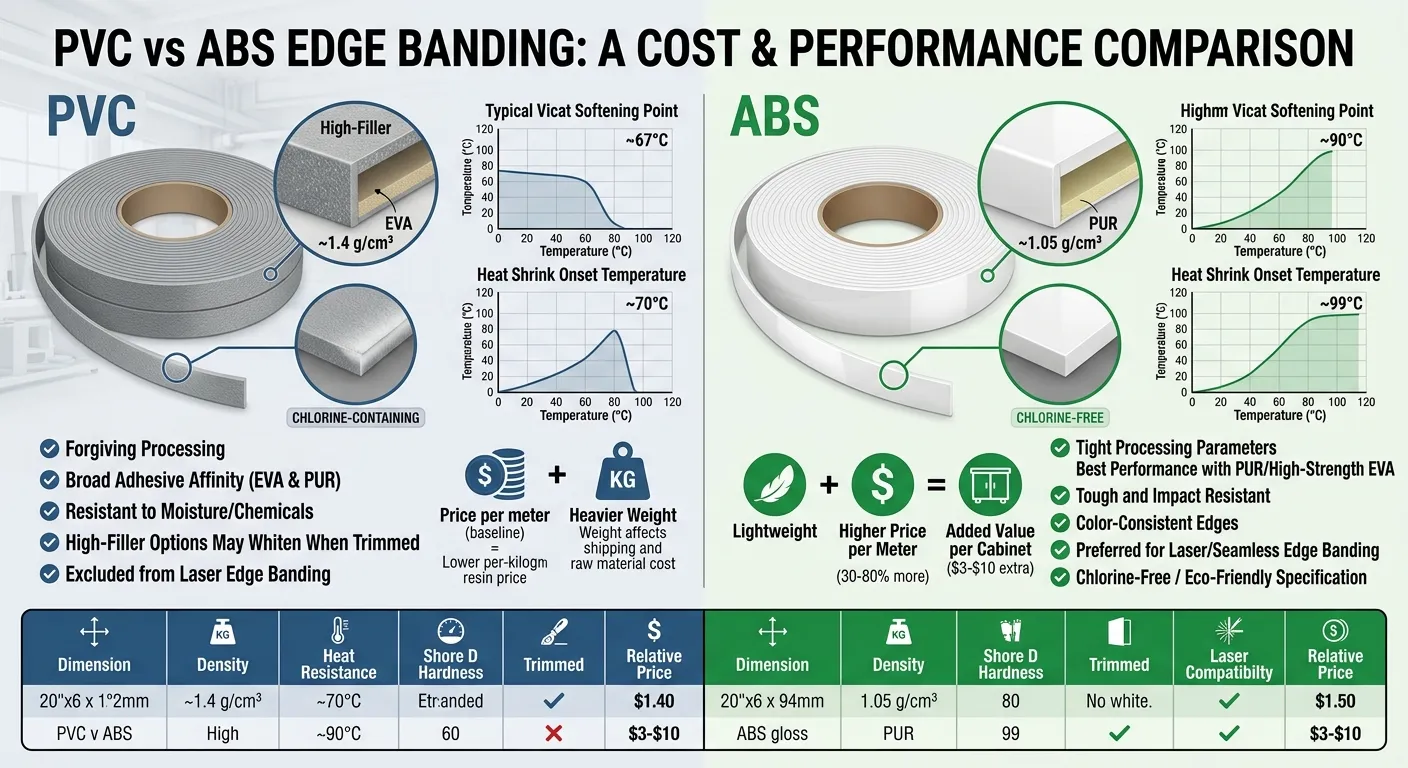
The real cost gap is smaller than the resin price suggests
- At resin level, ABS costs roughly twice as much per ton as PVC.
- But PVC is heavier. ABS density is about 1.05 g/cm³, while PVC runs around 1.4 g/cm³—low-cost PVC bands loaded with 30–40% calcium carbonate filler can reach 1.8. The same thickness and length of PVC simply weighs more, so a per-kilogram price comparison overstates the gap.
- On finished bands, ABS typically prices 30–80% above PVC for the same size.
- Per cabinet, that works out to roughly US$3–10 extra on an 80–100 meter edge length—seldom a deal-breaker for a kitchen cabinet.
The bigger cost differences hide elsewhere. With PVC, budget formulations can whiten at the trimmed edge, which means rework labor or a visible defect on light-colored doors. With ABS, the band costs more and needs a more precisely tuned line to deliver its advantages—switching materials without adjusting parameters wastes the premium you just paid.
PVC vs. ABS performance: heat, impact, and appearance
| Dimension | PVC Edge Banding | ABS Edge Banding |
|---|---|---|
| Density | ~1.4 g/cm³ (up to ~1.8 with heavy filler) | ~1.05 g/cm³ |
| Vicat softening point | ~67°C | ~90°C |
| Heat shrink onset | ~70°C | ~99°C |
| Shore D hardness | 79±4 (harder) | 70±4 (tougher) |
| Trimmed edge | May show white line with high filler | No whitening, color-consistent |
| Laser edge banding | Not recommended | Preferred material |
| Price per meter | Baseline | ~30–80% higher |
- Heat. PVC starts shrinking around 70°C; ABS holds until roughly 99°C. This matters for cabinets beside ovens, container shipments crossing the equator in summer, and warehouses without air conditioning—anywhere a lifted edge becomes a warranty claim.
- Impact. PVC’s higher Shore D hardness feels rigid; ABS is tougher and resists dents and cracks at high-traffic edges—office desks, kitchen base cabinets, children’s furniture.
- Trimming appearance. ABS contains no mineral filler, so the trimmed face keeps the surface color with no white line. High-filler PVC can whiten at the cut, which is exactly where premium doors show it.
- Moisture and chemicals. PVC resists water, detergents, and household solvents well, which is why it has ruled kitchens and bathrooms for decades. ABS handles standard cleaners fine too; the difference rarely decides an order.
- Laser and hot-air seamless edge banding. ABS is the standard choice, melting cleanly with a functional co-extruded layer for a glue-free seam. PVC is excluded—laser melting releases hydrogen chloride that corrodes machine optics, so most laser lines simply refuse it.
Processing, adhesive, and compliance considerations
PVC is forgiving: a wide process window, strong affinity with both EVA and PUR hot melt adhesives, and glue pot temperatures around 180–210°C. ABS demands tighter control of temperature, pressure, and tooling—and performs best with PUR or high-strength EVA to hit its full peel strength. If your line was set up around PVC, budget changeover and trial time before quoting ABS orders.
On compliance, the direction is one-way: European retailers and green building projects increasingly specify chlorine-free materials, making ABS (or PP) a de facto requirement for many export and children’s furniture orders. One more signal to watch: since January 2026, China has canceled the VAT export rebate on primary-form PVC, which may reshape feedstock pricing. None of this retires PVC—cost-driven markets keep it dominant, and no material matches its range of woodgrain, high-gloss, and metallic finishes.
How to choose between PVC and ABS
- Choose PVC when you run high-volume, cost-first lines: office furniture, standard carcasses, hidden interior edges (0.4–0.8 mm), humid kitchens and bathrooms, and markets with no chlorine-free requirement.
- Choose ABS when you export to Europe, build children’s, medical, or educational furniture, edge visible panels and high-touch surfaces (1.0–2.0 mm), work near heat sources, run laser or seamless edge banding, or position your brand as premium and eco-friendly.
- Or split the difference: PVC for carcasses and economy lines, ABS for doors, visible edges, and export orders. Most well-run factories do exactly this—it confines the ABS premium and the changeover effort to the orders that earn it back.
Validate the choice on your own production line
- Get quotes for both materials at the same thickness and width, in writing, per meter.
- Ask each supplier for Vicat softening point, impact strength, and color-difference test reports, plus REACH or equivalent certifications.
- Run a trial batch on your own machine and compare glue line, trim quality, and reject rate—not samples bent by hand.
- If your furniture faces strong sunlight, request UV aging data for the exact color you plan to order, because reported UV performance varies by formulation.
At Quanyixintong, we have manufactured PVC, ABS, PP, and acrylic edge banding since 2000, supplying leading Chinese furniture brands such as OPPEIN and ZBOM, as well as distributors across the Middle East, Southeast Asia, Europe, Central Asia, Africa, and the Americas. Because we produce both PVC and ABS bands—and manufacture the EVA and PUR hot melt adhesives that bond them—we can quote and sample both materials against your board, color, and line conditions, so you can decide on real numbers instead of sales claims. Send us your panel and edge banding specs, and we will produce matched samples of each for your own testing—you only place a bulk order after verifying the quality yourself. WhatsApp Paul at +86 18627833635, or visit our Wuhan factory to see both lines running.

